What is your name, where are you from, and what do you do?
My name is Isabelle Linnea Breslin, and I’m from Burlingame, California. I do a lot of things—I’m a florist and a multimedia artist.
What is art, and what makes someone an artist?
I have this debate with my dad all the time because he’s one of those people who doesn’t appreciate modern art and only sees fine arts as valuable. I think art can be anything that evokes something from the viewer—and I don’t think it even has to be intentional. I’d say an artist is someone who uses mediums to evoke something, which is broad, but true.
What is it about creating that you love so much?
It’s kind of just in my nature—not to be that person, but it’s something I’ve always done. As I’ve gotten older, I’ve questioned it more, but I think it’s something I need to do. It’s how my brain is wired. My parents have definitely influenced me—they’re both very artistic. My dad is a really good artist, and pretty much everyone in my family is artistic. My mom would always put me and my sisters in art classes, and we kind of have a legacy at this one art studio because we’ve all gone there since we were really young. My sister Sophia is pursuing comics and illustration, and my sister Emma studies art history and studio arts. That’s kind of off-topic, but yeah—as I’ve grown up, I’ve realized that I need time to create, otherwise I go insane.
You mentioned wanting to incorporate environmental advocacy into your artwork. Why is that important to you?
I really aspire to find something where I can integrate all of my interests into my career. I’m really indecisive—I’m sure you’ve noticed—but finding intersections between my interests is very important to me. The environmental stuff, in particular, is something that really stresses me out, and it should stress everyone out because it’s so pressing. Environmentalism intersects with everything—there are studies that show things like how shootings are more likely to occur on hotter days. That’s a random example, but there are so many intersections. I think art is a powerful way to get your point across. It doesn’t have to be political, but it can be—and it’s always vital to political or counter-movements.
Tell me about some of the mediums you’ve been working with lately.
I’m a trash lover. If anyone goes into my room, there’s trash on my walls—but it’s beautiful trash. There’s this whole wave of trinkets nowadays, but people don’t understand trinkets like I do. As a kid, my family called me the magpie because I’d go into my sisters’ rooms and steal their trinkets to hide under my pillow.
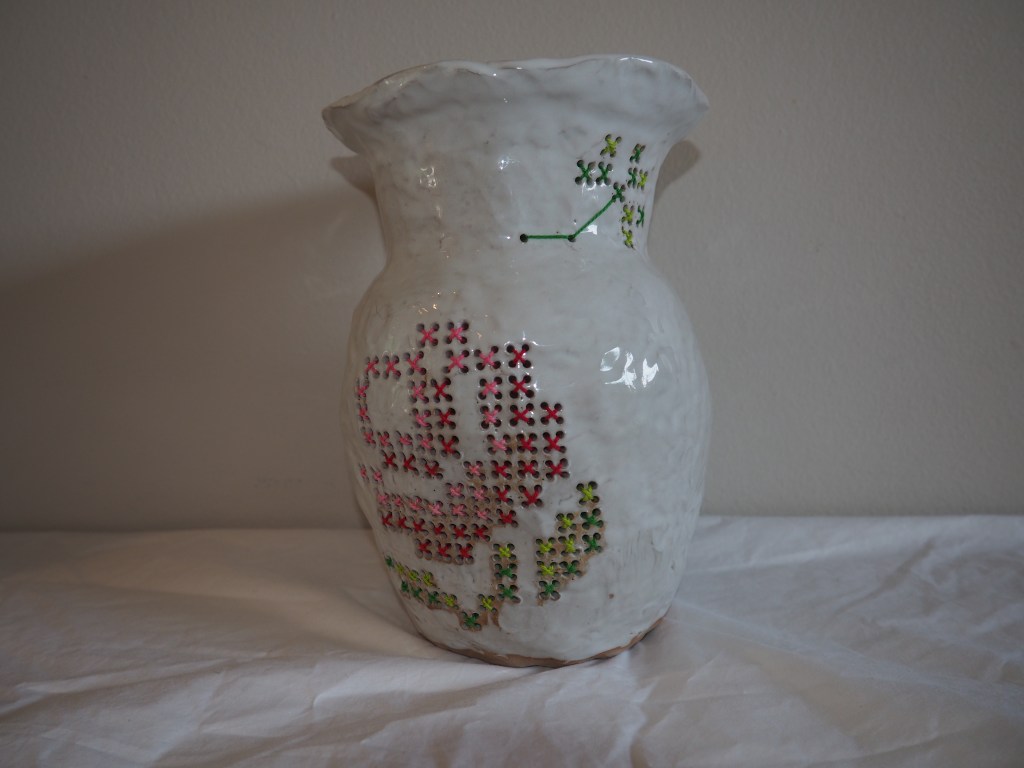
Anyway—mediums. Lately, I’ve been honing in on ceramics, which connects to environmentalism because it’s literally sourced from the earth. I really love hand-building—you can see every pinch and impression. When you can physically see the time put into a piece, it makes it extra beautiful. I also love multimedia. I made this one teapot where I used a bunch of beads and random trinkets to make the handle—it was kind of like a “junk necklace,” if you’ve ever seen one of those.
I recently took a black-and-white film photography class, and we worked in the darkroom and everything. Again, it comes back to process and being hands-on. I was doing test strips over and over—going in and out and in and out. There’s something about film and analog that makes photos so much more beautiful.
I know you want to transfer to art school soon. Tell me about where you want to go and why that’s important to you.
I’m looking to transfer to SCAD (Savannah College of Art and Design) in Georgia. They’re known for their connections and internship opportunities, and Savannah is just really beautiful. I’ve always had an interest in Georgia—it feels like a state that’s up-and-coming but also rich in culture.
Art school is tricky because it’s so expensive, but I think if you don’t go, you miss out on a certain kind of experience. I recently wrote a paper on The Tyranny of Merit: What’s Become of the Common Good by Michael Sandel, which talks about how college was originally meant to be a stepping stone for learning as much as you can—not just a ticket to a job. Art school gives you access to resources you can’t get elsewhere. For example, it’s really hard to find a darkroom outside of school. Same with ceramics—some studios in the Bay Area cost $400 a month, while community college is free. Honestly, community college is so valuable. I think everyone should go. Fucking community, bro. Anyway, shout out SCAD. The Bees.
Who are some artists that inspire you and your work?
I really love medieval art in all its forms. People have told me that some of my ceramic work looks like something you’d find in a tomb. I love art history in general, and how a piece can transcend time. Art’s timeless, bro.
My mom is a huge inspiration—especially when it comes to textiles. She’s an amazing artist, does really beautiful still lifes, and works in interior design. She’s also super supportive of me pursuing art, which I know a lot of parents aren’t.
You mentioned possibly doing an art residency at a Recology center. Tell me a little about that.
My ceramics teacher recommended it to me because she saw how much I love multimedia—that’s kind of the baseline for applying to the residency. Basically, you get to go through trash and make art with it. We’re really lucky in the Bay Area because people are much more conscious about this kind of thing compared to other places. I love junk and I love trash—Recology is the perfect intersection of all my interests. It feels like it was made just for me. So, hopefully, I get to do it.
Peace out.
 Pretty Things That Shine
Leave a comment